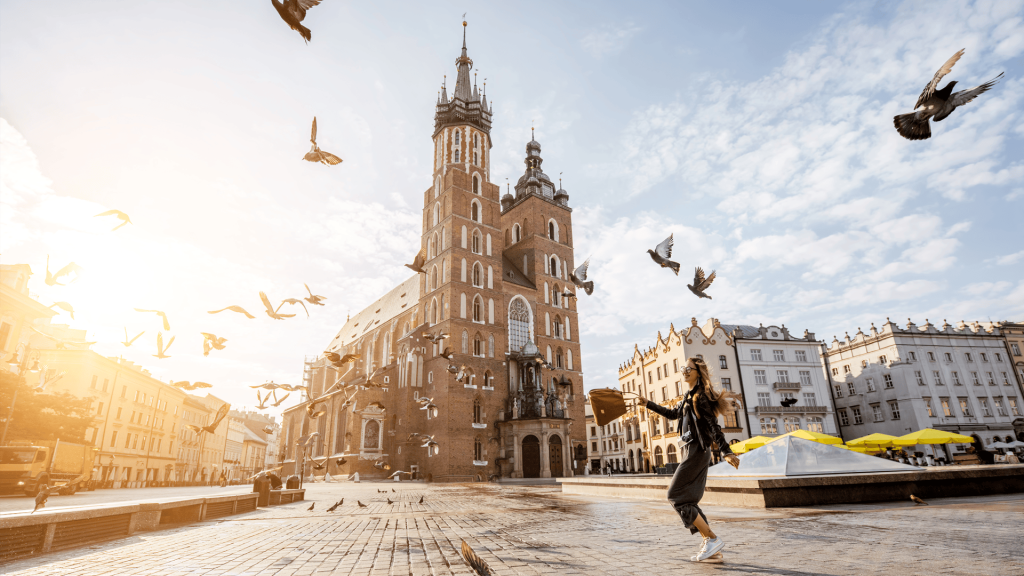
Country Overview
Poland is an attractive Central European destination, known for its rich history, vibrant cultural heritage, and rapidly developing economy. As the sixth-largest economy in the EU by nominal GDP, Poland blends medieval charm with modern infrastructure, with lively urban centres like Warsaw and Kraków alongside business hubs such as Wrocław, Poznań, Łódź, and Gdańsk.
Poland offers a highly educated workforce with deep expertise across IT, Financial Services, Business Process Outsourcing, Manufacturing, and Professional Services. With approximately 1 million foreign residents and growing, international teams integrate naturally. As an EU and NATO member, Poland operates under EU free movement rules for EU/EEA/Swiss citizens, while non-EU nationals require a points-style work permit and visa system.
*This guide is intended for general informational purposes only and should not be viewed as legal or tax advice. The information discussed may change frequently, and Access Financial cannot guarantee that all content remains current at all times.

2026 Key Legislative Updates
Minimum wage rises to PLN 4,806 gross per month from 1 January 2026 (no mid-year increase). EU Blue Card recast Directive took effect 13 February 2026 with shorter processing deadlines and easier employer changes. December 24 (Christmas Eve) is now a statutory public holiday, bringing the total to 14. December 24 is now a statutory public holiday. VAT registration threshold raised to PLN 240,000.
Contracts
Polish employment contracts define the terms of engagement — type, duration, notice, pay, and benefits. All employees are entitled to a written employment contract before commencing work, governed by the Polish Labour Code.
Contract Types
| Contract Type | Duration | Key Features |
|---|---|---|
| Permanent (Umowa o pracę na czas nieokreślony) | Indefinite | Open-ended; strongest job security; full Labour Code protections; termination requires valid reason and notice |
| Fixed-Term (Umowa na czas określony) | Specified end date | Capped at 33 months total and 3 consecutive renewals before converting to indefinite |
| Probationary (Umowa na okres próbny) | Up to 3 months | Trial contract; short notice periods; cannot be extended beyond 3 months |
| Civil Contracts (Umowa zlecenie / o dzieło) | Task-based | Governed by Civil Code, not Labour Code; limited protections; common for freelance work |

Fixed-Term to Permanent — 33-Month / 3-Contract Rule
Any combination of fixed-term contracts with the same employer cannot exceed 33 months in total, and you cannot have more than 3 consecutive fixed-term contracts. Beyond either limit, the contract automatically converts to an indefinite (permanent) contract — a key safeguard against serial fixed-term renewals.
What Your Contract Must Include
Mandatory in Writing
- Parties to the contract and date of conclusion
- Type of contract (permanent / fixed-term / probation)
- Job title, scope of duties, and place of work
- Gross remuneration and pay components
- Working time and start date
- Holiday entitlement
- Notice period (for fixed-term and indefinite)
- Reference to internal work rules (regulamin pracy)
Common Additional Clauses
- Confidentiality / NDA provisions
- Intellectual property assignment (with 50% deductible costs for creative work)
- Non-compete clause (paid for post-employment period)
- Bonus and commission structure
- Private medical care and benefits
- Mobility / business travel provisions
- Reference to internal regulations (PPK, bonus schemes)
Working Hours & Overtime
Standard full-time hours in Poland are 8 hours per day and 40 hours per week, typically Monday to Friday. The Labour Code caps average weekly hours, including overtime, at 48 hours over the settlement period (usually a quarter, extendable up to 12 months in justified cases).
| Parameter | Rule | Notes |
|---|---|---|
| Standard hours | 8 hrs/day, 40 hrs/week | Typically Monday–Friday |
| Maximum (incl. overtime) | 48 hrs/week avg | Averaged across the settlement period |
| Annual overtime cap | 150 hrs/year (default) | Higher cap (up to ~384 hrs) may be set in internal regulations |
| Daily rest | 11 consecutive hrs | Per 24-hour period — mandatory |
| Weekly rest | 35 hrs | Per 7-day period (includes 11 hrs daily rest) |
| Overtime premium | +50% / +100% | 50% on weekdays; 100% on nights, Sundays and holidays |
Working Hours & Overtime
The Polish Labour Code sets maximum hours, rest breaks, and overtime rules. Overtime is allowed only for special employer needs or rescue/accident response, and must be compensated by premium pay or time off in lieu.
| Parameter | Rule | Notes |
|---|---|---|
| Maximum weekly hours | 48 hrs avg | Averaged across the settlement period (typically 4 months, up to 12) |
| Standard full-time hours | 8 hrs/day, 40 hrs/week | Defined by the Labour Code |
| Annual overtime limit | 150 hrs | Higher caps possible via internal work regulations |
| Daily rest | 11 consecutive hrs | Per 24-hour period |
| Weekly rest | 35 hrs | Per 7-day period |
| Rest break (>6 hrs) | 15 min | Paid; included in working time |
| Overtime weekday rate | +50% | On top of normal hourly rate |
| Overtime night/Sunday/holiday | +100% | Double pay; or time off in lieu (1.5h per overtime hour if employer-initiated) |
Managerial Overtime Exception
High-level managerial staff are not entitled to overtime pay for hours needed to fulfil their duties, except for work on Sundays and holidays without a day off in lieu. Review managerial contract clauses carefully — many IT and senior consulting roles fall under this exception.
Probation Period
Probation in Poland is regulated by the Labour Code via a dedicated trial contract (umowa o pracę na okres próbny), capped at 3 months.
| Parameter | Standard practice | Legal notes |
|---|---|---|
| Maximum duration | 3 months | Set by the Labour Code; cannot be extended beyond 3 months |
| Notice during probation | 3 days / 1 week / 2 weeks | Depends on probation length (up to 2 wks / 2 wks–3 mths / full 3 mths) |
| Reason for termination | Not required | Either party can terminate without stating a reason |
| Day-one statutory rights | Full from day one | Annual leave (pro-rata), sick pay, ZUS coverage, discrimination protection |
| Re-trial with same employer | Generally not allowed | Only if hired for a substantially different role |
Immigration & Work Visas
Poland is part of the EU single market, so EU/EEA/Swiss citizens enjoy freedom of movement. Non-EU nationals require both a work authorisation and a long-stay visa, followed by a residence permit for stays beyond one year.
Revised EU Blue Card — February 2026
From 13 February 2026, Poland applies the recast EU Blue Card Directive: shorter processing deadlines, easier employer changes, minimum contract length of 6 months, no labour market test (abolished 1 June 2025), and a salary threshold of PLN 13,355.34 gross per month.
Main Work Authorisation Routes
| Route | Min. Salary / Eligibility | Sponsor? | Duration |
|---|---|---|---|
| Work Permit Type A | At least national minimum wage; market wage for the role | Polish employer | Up to 3 years; renewable |
| EU Blue Card | PLN 13,355.34 gross/month (150% avg wage); higher education or 5+ yrs experience | Yes (combined permit) | 2–3 years; renewable |
| Intra-Company Transfer (ICT) | Managerial / specialist / trainee criteria | Multinational group | Up to 3 years (1 yr for trainees) |
| Work Permit Type B | Board member / CEO residing >6 months/yr | Polish company | Up to 5 years |
| Temporary Residence + Work Permit | Combined permit; granted in Poland | Polish employer | Up to 3 years |
| Fee | Cost | Notes |
|---|---|---|
| Work permit application (Type A) | PLN 100 | For contracts up to 3 months: PLN 50 |
| National (D) visa application | EUR 80 | Paid at Polish consulate abroad |
| Temporary residence permit | PLN 340 | Filed at the Voivodeship Office |
| Residence card issuance | PLN 100 | Plastic ID card; valid 1–3 years |
Leave Entitlements
Poland’s statutory leave entitlements are generous, particularly for parental leave following the 2023 EU work-life balance reforms. Most professional employers layer additional perks on top of the statutory floor.
Annual Leave
| Parameter | Entitlement | Notes |
|---|---|---|
| Under 10 years tenure | 20 days/yr | Education counts in part toward tenure |
| 10+ years tenure | 26 days/yr | University degree counts as 8 years |
| Part-time | Pro-rata | Calculated proportionally to working time |
| Carry-over deadline | 30 September next year | Unused leave must be granted by end-Q3 of the following year |
Parental Leave
| Leave type | Duration | Pay | From |
|---|---|---|---|
| Maternity | 20 wks (31 for twins; up to 37 for quintuplets) | 100% of salary (or 81.5% if combined option chosen) | Day one |
| Paternity | 2 wks | 100% of salary | Within first 12 months |
| Parental | Up to 41 wks (43 for multiples) | 70% of salary; 9 wks reserved for each parent | After maternity |
| Childcare leave | Up to 36 months | Unpaid (some means-tested benefit) | Until child turns 6 |
| Carer’s leave | 5 days/yr | Unpaid | Day one (since 2023) |
Sick Leave (Zwolnienie Lekarskie / L4)
| Parameter | Rule |
|---|---|
| Standard rate | 80% of average salary |
| Hospital / pregnancy / work accident | 100% of average salary |
| First 33 days (or 14 if aged 50+) | Paid by employer |
| From day 34 (or 15 for 50+) | Paid by ZUS (Social Insurance Institution) |
| Maximum duration | 182 days (270 for TB / pregnancy) |
| Rehabilitation benefit | Up to 12 additional months if recovery is likely |
Public Holidays 2026
Poland observes 14 public holidays in 2026, including Christmas Eve (24 December), which became a statutory holiday in 2025. Holidays falling on Saturdays must be compensated with an extra day off.
| Date | Day | Holiday |
|---|---|---|
| 1 January | Thursday | New Year’s Day (Nowy Rok) |
| 6 January | Tuesday | Epiphany (Święto Trzech Króli) |
| 5 April | Sunday | Easter Sunday (Wielkanoc) |
| 6 April | Monday | Easter Monday (Poniedziałek Wielkanocny) |
| 1 May | Friday | Labour Day (Święto Pracy) |
| 3 May | Sunday | Constitution Day (Święto Konstytucji 3 Maja) |
| 24 May | Sunday | Pentecost (Zesłanie Ducha Świętego) |
| 4 June | Thursday | Corpus Christi (Boże Ciało) |
| 15 August | Saturday | Assumption of Mary / Polish Army Day |
| 1 November | Sunday | All Saints’ Day (Wszystkich Świętych) |
| 11 November | Wednesday | Independence Day (Święto Niepodległości) |
| 24 December | Thursday | Christmas Eve (Wigilia) |
| 25 December | Friday | Christmas Day (Boże Narodzenie) |
| 26 December | Saturday | Second Day of Christmas (Drugi Dzień Świąt) |
Notice Periods
Poland sets statutory notice periods by length of continuous service with the same employer. The same rules apply to both fixed-term and indefinite contracts since the 2016 reform.
| Length of service | Notice period | Applies to |
|---|---|---|
| Under 6 months | 2 weeks | Fixed-term & indefinite contracts |
| 6 months – 3 years | 1 month | Fixed-term & indefinite contracts |
| Over 3 years | 3 months | Fixed-term & indefinite contracts |
| Probation up to 2 wks | 3 working days | Probation contract |
| Probation 2 wks – under 3 mths | 1 week | Probation contract |
| Probation 3 mths | 2 weeks | Probation contract |
Termination & Severance
Polish employment law provides robust employee protections. Indefinite contract terminations by the employer must cite a valid reason and follow a formal written process; dismissal of pregnant employees and those near retirement is severely restricted.
| Length of service | Severance pay | Cap (2026) |
|---|---|---|
| Under 2 years | 1 month’s average salary | 15 × minimum wage = PLN 72,090 |
| 2 to under 8 years | 2 months’ average salary | 15 × minimum wage = PLN 72,090 |
| 8 years or more | 3 months’ average salary | 15 × minimum wage = PLN 72,090 |

Disciplinary Dismissal (Art. 52 KP)
Employers can dismiss without notice for gross misconduct (serious breach of duties, qualifying crime, or loss of required licences through the employee’s fault). The dismissal must be issued within 1 month of learning the cause and cite a specific reason — open to employee challenge before the labour court.
Income Tax
Poland’s tax year follows the calendar year. Employees are taxed monthly via PIT advance withheld by the employer; annual returns (PIT-37 / PIT-36) are due by 30 April.
Income Tax Bands 2026
| Band | Annual Income | Rate | Notes |
|---|---|---|---|
| Tax-free allowance | Up to PLN 30,000 | 0% | Kwota wolna od podatku — applied automatically |
| First bracket | PLN 30,001 – 120,000 | 12% | Minus PLN 3,600 tax-reducing amount |
| Second bracket | Above PLN 120,000 | 32% | PLN 10,800 + 32% of excess over PLN 120,000 |
| Solidarity surcharge | Above PLN 1,000,000 | +4% | Daninka solidarnościowa; applied on income over PLN 1M |
Expat-Friendly Tax Regimes
IP Box: 5% rate on qualifying IP income (patents, software). Return Relief: Poles relocating back to Poland exempt up to PLN 85,528/year for 4 years. Youth Relief: 0% PIT on first PLN 85,528 for those under 26. Flat 19%: Available for sole traders. Poland has double-tax treaties with most countries.
VAT
| Rate | % | Applies to |
|---|---|---|
| Standard | 23% | Most goods and services |
| Reduced | 8% | Hospitality, certain construction, pharmaceuticals |
| Reduced | 5% | Basic food, books, e-books, children’s products |
| Zero | 0% | Exports, intra-EU supplies, certain transport |
| Registration threshold | PLN 240,000 | Annual turnover (raised from PLN 200,000 in 2026) |
Benefits
Polish statutory benefits are comprehensive. Competitive employers in IT, finance, and professional services layer supplemental benefits to attract and retain talent in a tight labour market.
Mandatory Statutory Benefits
| Benefit | Rate / Amount | Notes |
|---|---|---|
| PPK (auto-enrolment pension) | 3.5% total min. | 1.5% employer + 2% employee; opt-out possible |
| Sick pay (employer-paid) | 80% / 100% | First 33 days (14 if 50+); standard / hospital-pregnancy-accident rates |
| Maternity pay | 100% (or 81.5% combined) | 20 weeks; paid by ZUS via payroll |
| Annual leave | 20 or 26 days/yr | Depends on tenure including education credit |
| Severance pay | 1–3 months’ salary | 20+ employee firms; reasons not attributable to employee |
| NFZ healthcare | 9% contribution | Free at point of use; covers spouse and children |
Market-Standard Supplemental Benefits
| Benefit | Prevalence | Typical provision |
|---|---|---|
| Private Medical Care | Standard at professional employers | Medicover / LuxMed / Enel-Med / Allianz |
| Multisport / Sports Card | Very common | Benefit Systems Multisport; gym & pool access |
| Life Assurance | Common | Group policy via insurer (often 3–6× salary) |
| Meal vouchers / Cafeteria | Common | Sodexo / Edenred / Pluxee; tax-efficient |
| Social Benefits Fund (ZFŚS) | Mandatory for 50+ employee firms | Holiday subsidies, cultural & sport vouchers |
| Remote / Hybrid Work | Standard post-2023 | Codified in Labour Code; remote work allowance required |
| Language courses | Common in MNCs | English, German, French — paid by employer |
Pension System
Poland operates a three-pillar system: the mandatory ZUS state pension, the workplace PPK (auto-enrolment), and voluntary private schemes (IKE / IKZE).
| Parameter | 2026 | Notes |
|---|---|---|
| Minimum State Pension | PLN 1,878.91/month gross | From 1 March 2026 indexation |
| State Pension age — women | 60 | Earliest claim age |
| State Pension age — men | 65 | Earliest claim age |
| ZUS contribution cap | PLN 282,600/yr | Pension & disability only; 30 × average wage |
| PPK employer minimum | 1.5% | Of gross salary; auto-enrolment for 18–55-year-olds |
| PPK employee minimum | 2% | Default; can be raised to 4% voluntarily |
| State PPK welcome bonus | PLN 250 + PLN 240/yr | Government incentive for participation |
| IKE / IKZE annual cap | PLN ~25,000 / 10,000 | Voluntary tax-advantaged savings |
Insurances
Mandatory and recommended insurances for employers, employees, and contractors in Poland.
| Insurance | Coverage | Required by |
|---|---|---|
| NFZ Health Insurance | Public healthcare access | Mandatory for all workers contributing to ZUS |
| Accident Insurance (wypadkowe) | Workplace injury | Mandatory ZUS contribution by employer (0.67–3.33%) |
| Motor Third-Party Liability (OC) | Third-party road damage | Compulsory for all vehicle owners |
Professional Indemnity Insurance — Contractors
Often contractually required by Polish end-clients, especially for IT, financial services, and consulting engagements. Mandatory by law for certain regulated professions (lawyers, accountants, architects, insurance brokers). Minimum PLN 1M cover typical; PLN 2M+ for finance and tech roles. AF can advise on appropriate cover.
Private Health Insurance
| Provider | Typical monthly cost | Type |
|---|---|---|
| Medicover | PLN 150–350 (individual) | Comprehensive medical subscription |
| LuxMed | PLN 140–320 (individual) | Comprehensive medical subscription |
| Enel-Med | PLN 120–280 (individual) | Comprehensive medical subscription |
| Allianz / PZU Zdrowie | PLN 100–250 (individual) | Insurance + clinic network |
AF Solutions
Access Financial has operated in Poland for over 22 years, supporting end-clients, recruitment agencies, and contractors.
For End-Clients
Managing a contingent workforce can be complex. Our solutions streamline workforce management, making it simple, compliant, and cost-effective.
For Recruiters
We offer a complete suite of services, allowing you to simply, compliantly, and efficiently place your candidates internationally, with minimum fuss.
For Contractors
Focus on what you do best and let us take care of your payroll, tax compliance, social security, and immigration needs.

Free Consultation
FAQ
Find answers to our most frequently asked questions below.
What solutions do you offer in Poland?
In Poland, Access Financial provides one compliant engagement model:
Self-employment: Where an engagement genuinely meets the criteria for self-employed status, we register the contractor compliantly, manage their filing obligations throughout the contract term, and deregister them at the end of the assignment.
Is contractor misclassification a high risk under an AOR engagement?
Misclassification typically occurs when contractors are treated as employees in practice — fixed hours, integration into the team, no right of substitution, direct supervision, and so on. Prevention requires clear engagement frameworks, standardised processes, documented evidence of independence, and recurring audits. Accountability and the right technology are key to staying compliant at scale, particularly as tax authorities increasingly use data analytics and algorithmic checks to flag suspect arrangements.
At Access Financial, we help our clients minimise this risk by designing tailored classification frameworks, onboarding checklists, contractual safeguards, and recurring compliance audits.
What is your pricing model?
Our standard management fee is 5% of the contract value, with a minimum of €550. We also offer volume discounts on bulk engagements. To discuss pricing for your specific scenario, please get in touch with our team here: https://accessfinancial.com/#get-started.







Social Insurance (ZUS)
The Social Insurance Institution (ZUS) administers Poland’s mandatory contributions covering pensions, disability, sickness, accident, and the Labour Fund. Separately, the 9% health insurance contribution funds public healthcare (NFZ).
2026 ZUS Updates
Annual pension/disability contribution cap rises to PLN 282,600 (30 × forecast average wage). Mały ZUS Plus available for 36 months in every 60 months of activity. New entrepreneurs continue to benefit from 6 months ZUS exemption (ulga na start), then 24 months at preferential rate (PLN 1,441.80 base = ~PLN 456 monthly).
Employer Contributions
Employee Contributions