Country Overview
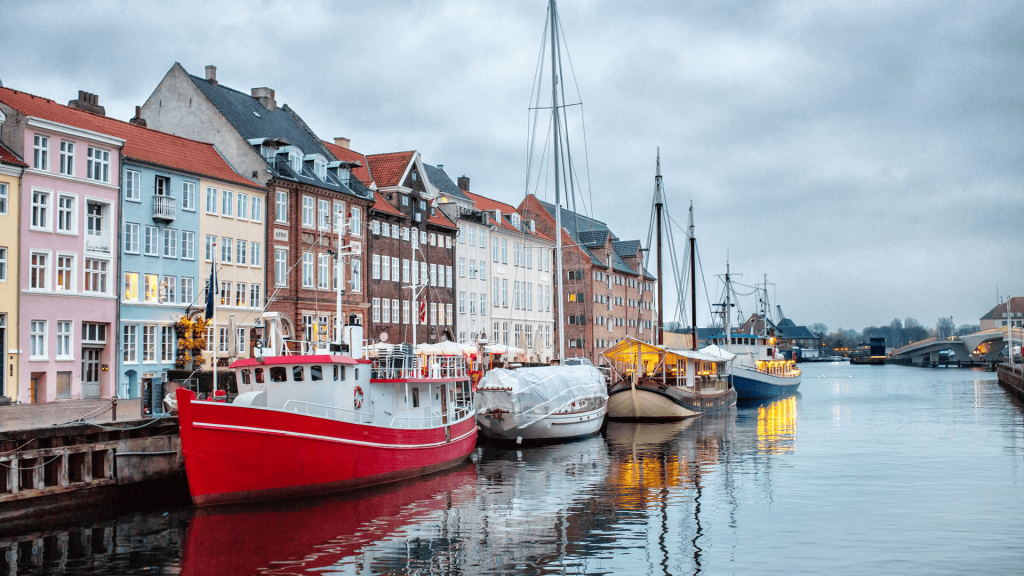
Denmark is a highly attractive destination for international professionals, known for its excellent quality of life, modern welfare system, and efficient public services. From the historic charm of Copenhagen’s waterfront Nyhavn to the innovation hubs around Aarhus, Denmark offers a blend of rich cultural heritage and a forward-thinking work environment.
Denmark consistently ranks among the world’s happiest and most developed nations, with a strong economy built on Pharmaceuticals, Renewable Energy, Maritime Shipping, Technology, and Life Sciences. English proficiency is among the highest in the world, making integration easy for international professionals. Approximately 14% of residents are of foreign origin, supported by a points-based work permit system for non-EU nationals.
*This guide is intended for general informational purposes only and should not be viewed as legal or tax advice. The information discussed may change frequently, and Access Financial cannot guarantee that all content remains current at all times.

2026 Key Legislative Updates
A new tax reform introduces a three-tier top tax structure: mellemskat (middle tax) of 7.5%, topskat (top tax) of 7.5%, and a new toptopskat of 5% on income above DKK 2,818,152. The Pay Limit Scheme threshold rises to DKK 552,000/year. The expat tax scheme (27% rule) minimum monthly salary drops to DKK 65,400, broadening access for international hires. State pension age rises to 67.
Contracts
Danish employment contracts (ansættelseskontrakt) define the terms of engagement — type, duration, notice, pay, and benefits. Denmark’s labour market operates under the “Danish Model” or “flexicurity” — flexibility for employers combined with security for employees through collective agreements (overenskomst) and strong statutory protections.
Contract Types
| Contract Type | Duration | Key Features |
|---|---|---|
| Permanent (indefinite) | Open-ended | Most common; continues until terminated by either party with notice |
| Fixed-Term | Specified end date | Often for projects or maternity cover; repeated extensions may convert to permanent rights |
| Part-Time | Indefinite or fixed | Pro-rata rights equal to full-time; no less favourable treatment permitted by law |
| Consultancy (B2B) | Project-based | Independent contractor using own CVR; not subject to employment law protections |

Collective Agreements (Overenskomst)
Many Danish workplaces are covered by collective bargaining agreements at industry or company level. These set minimum salaries, overtime premiums, pension contributions, extra holidays, and notice periods. If your contract references an overenskomst, those terms apply automatically and often provide better conditions than statutory minimums.
What Your Contract Must Include
Mandatory Terms
- Job title and description
- Start date and contract duration (if fixed-term)
- Salary, pay frequency, and any bonus structure
- Working hours and workplace location
- Holiday entitlement (5 weeks statutory)
- Notice periods (per Salaried Employees Act)
- Pension contribution arrangements
- Reference to applicable collective agreement
Common Additional Clauses
- Confidentiality / NDA provisions
- Intellectual property assignment
- Restrictive covenants (non-compete, non-solicit)
- Probation period (up to 3 months)
- Overtime arrangements (often “salary inclusive”)
- Free Movement Day supplement (0.45%)
- Coverage under Salaried Employees Act (Funktionærloven)
Access Financial drafts Danish-compliant employment contracts and manages onboarding for EOR engagements.
Working Hours & Overtime
Denmark implements the EU Working Time Directive. Standard full-time hours are 37 per week — typically 7.5 hours per day, Monday to Friday, with an unpaid 30-minute lunch break. Danes are known for respecting work-life balance, with most employees leaving on time for family commitments.
| Parameter | Rule | Notes |
|---|---|---|
| Standard full-time hours | 37 hrs/week | Set by collective agreement; not statutory |
| Maximum weekly hours | 48 hrs/week avg | Calculated over 4-month reference period (EU Directive) |
| Daily rest | 11 consecutive hrs | Per 24-hour period — mandatory |
| Weekly rest | 24 hrs | Per 7-day period; usually Sunday |
| Night work | Max 8 hrs avg | Limits apply to regular night-shift workers |
| Overtime pay | No statutory rate | Subject to contract or collective agreement; commonly 50% premium |
Overtime in Practice
For salaried funktionær roles, contracts often state “salary is inclusive of overtime” — meaning occasional extra hours are expected without additional pay. For workers covered by collective agreements, overtime is typically paid at 50% premium for the first hours and 100% for late-night or weekend work, with the option of TOIL (time off in lieu).
Probation Period
Probationary periods (prøvetid) are contractual rather than statutory in Denmark. For salaried employees under the Salaried Employees Act, the maximum probation period is 3 months.
| Parameter | Standard practice | Legal notes |
|---|---|---|
| Typical duration | Up to 3 months | Maximum for funktionærer under the Salaried Employees Act |
| Notice during probation | 14 days (either side) | Must be set in contract; can expire before probation ends |
| Extension | Not permitted | 3-month cap is statutory for salaried employees |
| Day-one statutory rights | Full from day one | Holiday accrual, sick pay, discrimination protection apply immediately |
Immigration & Work Visas
Denmark operates a structured immigration system for non-EU professionals. EU/EEA/Swiss nationals have free-movement rights, while UK citizens (post-Brexit) and other third-country nationals require a combined work-and-residence permit.
Pay Limit Scheme Threshold — 2026
The minimum salary under the Pay Limit Scheme has risen to DKK 552,000/year (DKK 46,000/month) in 2026, up from DKK 514,000 in 2025. A supplementary Pay Limit Scheme is also available with a lower threshold of DKK 446,000/year under additional conditions. SIRI application fees have also increased from January 2026.
Main Work Permit Routes
| Visa Route | Min. Salary (2026) | Sponsor? | Duration |
|---|---|---|---|
| Pay Limit Scheme | DKK 552,000/yr | Yes | Up to 4 years; renewable |
| Supplementary Pay Limit | DKK 446,000/yr | Yes | Up to 4 years; conditional |
| Positive List (Skilled / Highly Educated) | No minimum | Yes | Contract length, up to 4 years |
| Fast-Track Scheme | DKK 552,000/yr | Certified company | Up to 4 years; expedited |
| EU Blue Card | DKK 552,000/yr | Yes (12-month contract) | Up to 4 years; EU mobility |
| Researcher Scheme | No minimum | Research institution | Contract length |
| Start-up Denmark | N/A (business plan) | Approval panel | 2 years; renewable |
Residence Permits & Registration
Non-EU residence permits are issued as a physical card after arrival. EU/EEA citizens must obtain an EU registration certificate from SIRI within 3 months of arrival. All new residents must then register with the local municipality (kommune) or International Citizen Service (ICS) to receive a CPR number — Denmark’s central personal identification number, essential for banking, mobile contracts, healthcare, and tax filing.
AF’s immigration team supports contractors and professionals relocating to Denmark. We handle work permit applications, CPR registration, and SIRI compliance.
Leave Entitlements
Denmark’s statutory leave entitlements are among the most generous in Europe, governed by the Danish Holiday Act (Ferieloven) and parental leave legislation reformed in August 2022.
Annual Leave
| Parameter | Entitlement | Notes |
|---|---|---|
| Statutory minimum | 25 days/yr (5 weeks) | Accrued at 2.08 days per month under concurrent holiday system |
| Holiday year | 1 September – 31 August | Days taken concurrently as earned |
| Carry-over | Up to 5 days | By mutual agreement; more under some collective agreements |
| Market standard (professional) | 5–6 weeks | Many employers add a 6th week via collective agreement |
Parental Leave
| Leave type | Duration | Pay | From |
|---|---|---|---|
| Pregnancy leave | 4 weeks before due date | State benefit / employer salary | Day one |
| Maternity leave | 10 weeks after birth | State benefit / employer salary | Day one |
| Paternity leave | 2 weeks after birth | State benefit / employer salary | Day one |
| Parental leave (each parent) | 32 weeks each (11 earmarked) | State benefit up to DKK 5,085/wk (2026) | Until child is 9 |
Sick Leave (Sygefravær)
| Parameter | Rule |
|---|---|
| Pay during illness | Full salary for salaried employees (funktionærer) |
| Employer reimbursement | State reimburses employer after 30 days |
| Maximum (sygedagpenge) | Up to 22 weeks in a 9-month period |
| Doctor’s note required | Typically after 5+ days; earlier on request |
| Waiting days | None — pay from day one |
Public Holidays 2026
Denmark has 10 statutory public holidays in 2026, following the abolition of Great Prayer Day (Store Bededag) in 2024. Employees are compensated for the lost day with a 0.45% supplement to annual salary.
| Date | Day | Holiday | Type |
|---|---|---|---|
| 1 January | Thursday | New Year’s Day (Nytårsdag) | Statutory |
| 2 April | Thursday | Maundy Thursday (Skærtorsdag) | Statutory |
| 3 April | Friday | Good Friday (Langfredag) | Statutory |
| 5 April | Sunday | Easter Sunday (Påskedag) | Statutory |
| 6 April | Monday | Easter Monday (2. Påskedag) | Statutory |
| 14 May | Thursday | Ascension Day (Kristi Himmelfartsdag) | Statutory |
| 24 May | Sunday | Whit Sunday (Pinsedag) | Statutory |
| 25 May | Monday | Whit Monday (2. Pinsedag) | Statutory |
| 5 June | Friday | Constitution Day (Grundlovsdag) | Not statutory; commonly half/full day off |
| 25 December | Friday | Christmas Day (Juledag) | Statutory |
| 26 December | Saturday | Boxing Day (2. Juledag) | Statutory |
Notice Periods
The Danish Salaried Employees Act (Funktionærloven) sets statutory minimum notice periods based on length of service. All notice expires at the end of a calendar month.
| Length of service | Employer notice (statutory) | Employee notice |
|---|---|---|
| Up to 6 months | 1 month | 1 month |
| Over 6 months – 3 years | 3 months | 1 month |
| Over 3 – 6 years | 4 months | 1 month |
| Over 6 – 9 years | 5 months | 1 month |
| Over 9 years | 6 months | 1 month |
Termination & Severance
Denmark does not operate at-will employment. Dismissals must be objectively justified — typically redundancy, performance, or conduct grounds — and follow a fair process. Statutory severance applies to long-serving salaried employees.
| Length of service | Statutory severance | Eligibility |
|---|---|---|
| Under 12 years | None (only notice) | Notice period salary only |
| 12 + years | 1 month’s salary | Salaried employees (funktionærer) |
| 17 + years | 3 months’ salary | Salaried employees (funktionærer) |

Fair Dismissal Required
Employees with 1+ year’s service are protected against unfair dismissal under the Salaried Employees Act. Dismissals must be based on objective grounds — financial reasons, restructuring, or documented performance/conduct issues. Improper dismissals can result in compensation up to 6 months’ salary depending on tenure and circumstances.
Income Tax
Denmark’s tax system is progressive and consists of national tax, municipal tax, AM-bidrag, and optional church tax. All employees are taxed at source via the PAYE-equivalent system (eIndkomst), with annual tax assessments (årsopgørelse) issued each March.
Income Tax Structure 2026
| Tax component | Annual income | Rate 2026 | Notes |
|---|---|---|---|
| AM-bidrag | All gross income | 8% | Deducted off the top; no allowance |
| Personal allowance | Up to DKK 54,100 | 0% | Tax-free threshold (up from DKK 51,600 in 2025) |
| Bottom-bracket state tax | Above DKK 54,100 | 12.01% | Applied to all income over personal allowance |
| Municipal tax (average) | Above DKK 54,100 | ~25.05% | Range: 23.39% (Copenhagen) to 26.30% |
| Middle tax (mellemskat) — NEW 2026 | Above DKK 696,956 | 7.5% | Replaces part of old top tax |
| Top tax (topskat) | Above DKK 845,543 | 7.5% | Threshold significantly raised in 2026 |
| Top-top tax (toptopskat) — NEW 2026 | Above DKK 2,818,152 | 5% | New highest band |
| Church tax (optional) | Above DKK 54,100 | 0.4–0.9% | Members of the Danish National Church only |
Expat Tax Scheme (27% Rule) — Expanded in 2026
Eligible foreign hires can opt for a flat 27% tax (plus 8% AM) for up to 7 years — an effective rate of around 32.84%. The minimum monthly salary requirement has been reduced to DKK 65,400 in 2026 (from DKK 78,000 in 2025), opening the scheme to a wider pool of international professionals.
VAT (Moms)
| Rate | % | Applies to |
|---|---|---|
| Standard | 25% | Most goods and services |
| Zero | 0% | Newspapers (printed and digital) |
| Exempt | — | Financial services, healthcare, education, residential rental |
| Registration threshold | DKK 50,000 | Annual turnover above which VAT registration is mandatory |
Let Access Financial handle your Danish payroll — seamlessly and compliantly, with local specialists on call.
Benefits
Denmark’s statutory benefits cover universal healthcare, pension, parental leave, and unemployment insurance through the welfare state. Competitive employers add supplementary benefits to attract international talent.
Mandatory Statutory Benefits
| Benefit | Rate / Amount | Notes |
|---|---|---|
| Universal healthcare | Free at point of use | Funded via taxation; CPR registration required |
| ATP supplementary pension | ~DKK 3,408/year | Two-thirds employer, one-third employee |
| Parental leave benefit | Up to DKK 5,085/wk | Up to 52 weeks combined; state-paid (2026) |
| Sick pay | Full salary (funktionærer) | Employer pays first 30 days, then state benefit |
| Annual leave | 25 days/yr | 5 weeks under the Holiday Act |
| State pension (Folkepension) | ~DKK 7,100/month | From age 67 (2026), residence-based |
Market-Standard Supplemental Benefits
| Benefit | Prevalence | Typical provision |
|---|---|---|
| Occupational pension | ~90% of employees | 12–18% of salary (employer + employee share) |
| Private health insurance | Very common | Quick-access plans via PFA, Topdanmark, Codan |
| Sygeforsikring “danmark” | Over 2 million members | Reimburses dental, optical, physio, chiropractor |
| 6th week of holiday | Common via collective agreement | Additional week beyond statutory minimum |
| Free Movement Day supplement | Standard since 2024 | 0.45% salary supplement (Great Prayer Day compensation) |
| Remote / flexible working | Standard post-2021 | Hybrid 2–3 days common in professional roles |
| Lunch scheme (frokostordning) | Common in offices | Subsidised canteen or lunch allowance |
Pension System
Denmark’s pension system is consistently ranked among the world’s best for sustainability and adequacy. It consists of three pillars: state pension (Folkepension), ATP supplementary pension, and occupational/private pensions.
| Parameter | 2026 | Notes |
|---|---|---|
| State pension (Folkepension, single) | ~DKK 7,100/month | Before tax; rate adjusted annually |
| State pension age | 67 | Rising to 68 in 2030, 69 in 2035; tied to life expectancy |
| Residence requirement (new rule) | 9/10ths of period from 15 to retirement | Replaces 40-year rule for those reaching retirement after 30 June 2025 |
| ATP supplementary pension | Up to DKK 26,500/year | Full career contributions; lifelong annuity |
| Occupational pension contribution | 12–18% of salary | Typical; varies by collective agreement |
| Minimum pension age (private/occupational) | 55 (rising to 57 in 2028) | For tax-favoured withdrawal |
| Early withdrawal tax (non-residents) | 60% | Penalty for leaving DK and cashing out |
Insurances
Most insurance needs in Denmark are met by the welfare state. Mandatory insurances for employers and recommended cover for contractors are summarised below.
| Insurance | Min. Cover | Required by |
|---|---|---|
| Occupational Injury Insurance (AES) | Statutory cover | Workers’ Compensation Act — all employers |
| Motor third-party insurance | Statutory minimum | Road Traffic Act |
| Public health (sundhedskort) | Universal cover | Automatic on CPR registration — free at point of use |
Professional Indemnity (Erhvervsansvarsforsikring) — Contractors
Often contractually required by Danish end-clients for consultants, IT contractors, architects, engineers, and other professionals. Some regulated professions (lawyers, accountants, insurance brokers) are required by law to maintain PI cover. Minimum DKK 5–10M is standard; technology and financial services often require higher limits.
Supplementary Health Insurance
| Provider | Typical monthly cost | Type |
|---|---|---|
| Sygeforsikring “danmark” | DKK 50–200 (individual) | Mutual reimbursement plan (dental, optical, physio) |
| PFA Helbredssikring | DKK 200–500 (individual) | Quick-access private treatment |
| Topdanmark Sundhedsforsikring | DKK 200–450 (individual) | Comprehensive private cover |
| Codan / Tryg Sundhed | DKK 200–500 (individual) | Comprehensive private cover |
AF Solutions
Access Financial supports end-clients, recruitment agencies, and employees across Denmark, with deep expertise in local payroll, tax compliance, and the expat tax scheme (27% rule).
For End-Clients
Managing a contingent workforce can be complex. Our solutions streamline workforce management, making it simple, compliant, and cost-effective.
For Recruiters
We offer a complete suite of services, allowing you to simply, compliantly, and efficiently place your candidates internationally, with minimum fuss.
For Contractors
Focus on what you do best and let us take care of your payroll, tax compliance, social security, and immigration needs.

Free Consultation
FAQ
Find answers to our most frequently asked questions below.
What solutions do you offer in Denmark?
In Denmark, Access Financial provides one compliant engagement model:
Employed/EOR (umbrella): We become the legal employer of your employees in Denmark. Your business retains full control of the day-to-day work and deliverables, while we carry the employment, payroll, and tax liability.
When should a company consider using an EOR?
An EOR is especially useful in a range of scenarios. It is the most efficient route when you want to convert existing contractors into compliant employees and reduce misclassification risk, or when you need to hire talent in a country where you do not have a local entity. It also allows you to onboard quickly without going through a lengthy and complex company registration process, while ensuring full compliance with local employment law, payroll, and tax regulations. Beyond these core use cases, an EOR is equally valuable when you are testing a new market before committing to a long-term investment, or when you simply need temporary or project-based hires abroad.
Can we hire both local nationals and foreign employees through an EOR?
Yes. Our EOR services cover both local nationals and foreign hires. For foreign nationals, additional visa or work permit requirements apply, and we can support the application process end-to-end — including sponsorship in jurisdictions where we hold the relevant licence.
Is permanent establishment (PE) risk avoided?
An EOR is a third-party business that legally employs international workers on your behalf, creating a clear layer of separation between your company and the staff based in other countries. The EOR becomes the legal employer for those workers, so although the employees continue to deliver services to your business, the legal distancing helps mitigate many common PE risks. That said, PE is determined by the facts on the ground (the nature of the activity, contract-signing authority, where revenue is generated, and so on), not solely by who issues the payslip. We therefore recommend reviewing each engagement with our specialists to confirm the appropriate structure.
What is your pricing model?
Our standard management fee is 5% of the contract value, with a minimum of €550. We also offer volume discounts on bulk engagements. To discuss pricing for your specific scenario, please get in touch with our team here: https://accessfinancial.com/#get-started.








Social Security
Unlike most European countries, Denmark funds its welfare system primarily through general taxation rather than large payroll contributions. The main employee social charge is the 8% Labour Market Contribution (AM-bidrag), with small supplementary fees for ATP and other labour funds.
Low Payroll Burden
Denmark’s combined employer social charges are around DKK 12,000–15,000 per employee per year — one of the lowest in Europe. The trade-off is high personal income tax, which funds the welfare state directly.
Employer Contributions
Employee Contributions