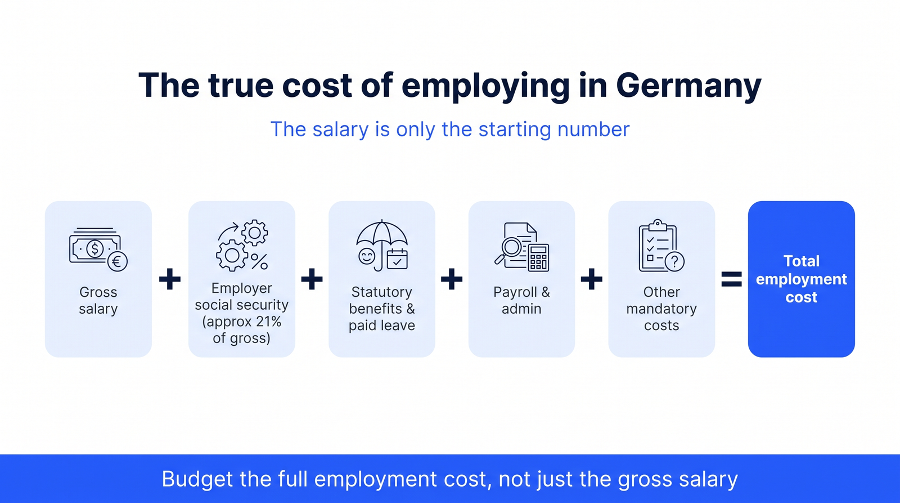
The true cost of employment in Germany is well above the gross salary. Employers add roughly 21% in social security contributions, plus employer-only accident insurance, statutory paid leave, up to six weeks of sick pay and payroll administration. Budget the total employment cost, not just the headline salary — or Finance reopens the numbers after the offer is out.
Key takeaways
The true cost of employment in Germany is the gross salary plus employer social security (about 21%), accident insurance, statutory benefits and payroll admin — commonly 20–25% on top of gross.
In 2026 the four social-security rates are broadly stable, but the contribution ceilings rose: €8,450 per month for pension and unemployment, €5,812.50 per month for health and long-term care.
Contributions are capped at those ceilings, so the effective on-cost percentage falls for salaries above the caps.
Accident insurance is paid entirely by the employer and varies by industry; small insolvency and apportionment levies add a little more.
Comparing a German hire with one in another country on salary alone is the classic budgeting error — Germany has its own employment-cost model.
Why is the salary not the total cost of a German hire?
The salary is not the total cost because German employers must add mandatory on-costs to every gross wage: social security of about 21%, employer-only accident insurance, continued pay during sickness, statutory leave and payroll administration. These are legal obligations, not optional extras — so the real budget line is the total employment cost.
The gross salary is the number everyone agrees on. The second number — the one that catches people off guard — is the layer of employer costs stacked on top. Compare a German hire with one made in another European country and the gross can look almost identical while the loaded cost does not, because each country runs its own model.
The pattern we see when a company benchmarks a German hire against, say, a Dutch or Irish one is exactly that: the gross matches, the fully-loaded figure does not, once employer-only accident insurance and the German ceilings are applied. Left out of the budget early, those costs surface later — when the offer is already on the table and Finance has to revisit it.
What makes up the true cost of employment in Germany?
The true cost of employment in Germany is built from six layers: gross salary, employer social security contributions, employer-only accident insurance, statutory benefits (leave, sick pay, holidays), payroll and admin, and other mandatory levies. The table shows the 2026 employer rates and the ceilings they apply up to.
Cost layer
Employer basis (2026)
Ceiling / note
Gross salary
100% (the agreed figure)
Base for everything below
Pension insurance
9.3% (half of 18.6%)
Up to €8,450/mo (€101,400/yr)
Health insurance
~8.75% (7.3% + half the ~2.9% supplement)
Up to €5,812.50/mo (€69,750/yr)
Long-term care insurance
1.8% (1.3% in Saxony)
Up to €5,812.50/mo; childless surcharge is employee-only
Unemployment insurance
1.3% (half of 2.6%)
Up to €8,450/mo (€101,400/yr)
Accident insurance
Employer only; ~1% average, sector-based
Set by the Berufsgenossenschaft
Insolvency & apportionment levies
Employer only; minor (typically well under 1%)
Insolvenzgeldumlage, U1/U2
≈ Employer on-cost
≈ 21% of gross (four branches) + accident & levies
Effective rate falls above the ceilings
On top of those percentage-based costs sit statutory obligations that do not show up as a contribution rate but are just as real: at least 20 days of paid annual leave on a five-day week (25–30 is the market norm), up to six weeks of continued full pay per illness, and 9–13 paid public holidays depending on the federal state. Employers must also operate wage-tax (Lohnsteuer) withholding and monthly returns — a payroll tax and administration burden, even though the tax itself comes out of the employee’s pay. Getting these right is what compliant payroll in Germany actually involves.
How much do employer social security contributions add in 2026?
Employer social security contributions in Germany add about 21% of gross wage in 2026 across four branches — pension 9.3%, health about 8.75%, long-term care 1.8% and unemployment 1.3% — up to the annual ceilings. Employer-only accident insurance and minor levies push the total employer on-cost a little higher.
According to Germany Trade & Invest, the employer’s share of the four statutory branches comes to roughly 21% of the gross wage; only accident insurance is borne entirely by the employer. The headline rates are stable for 2026, but the contribution ceilings rose: €8,450 per month for pension and unemployment and €5,812.50 per month for health and long-term care, with the average health supplement up to 2.9%. Because contributions stop at those ceilings, the effective employer percentage is lower for high earners.
Worked example — €70,000 gross
Gross salary: €70,000. Employer social security at ~21%: about €14,700. Accident insurance and minor levies: roughly €1,000–€1,500. Total employment cost: about €85,700–€86,200 — some 22–23% above the gross. Treat this as illustrative: the exact figure depends on the health fund’s supplement, the sector accident rate and the ceilings, so confirm it with a payroll calculation.
The full employment-cost checklist
Work through this before you approve a German hire — not after the offer is on the table:
Start with the agreed gross salary — the base for every contribution and benefit below.
Add employer social security contributions (~21%): pension 9.3%, health 7.3% plus half the ~2.9% supplement, long-term care 1.8%, unemployment 1.3% — each only up to its ceiling.
Add employer-only accident insurance (Berufsgenossenschaft) — sector-based, roughly 1% of gross on average.
Add the minor employer levies — insolvency (Insolvenzgeldumlage) and the U1/U2 apportionment charges.
Budget statutory paid leave — at least 20 days on a five-day week; 25–30 is what the market typically expects.
Budget continued pay in sickness — up to six weeks at full pay per illness, funded by the employer.
Account for public holidays — 9 to 13 paid days depending on the federal state (Land).
Provide the company-pension subsidy — a 15% employer top-up on salary-sacrifice contributions (bAV).
Add any customary extras — a 13th-month payment (Weihnachtsgeld), bonuses or benefits — where the market or a collective agreement expects them.
Add the running costs — recruitment, setup and compliant payroll administration (wage-tax filing and monthly returns).
Confirm the total employment cost is approved — not just the salary — before the offer goes out.
What are the common mistakes when budgeting a German hire?
The common mistakes are budgeting the gross salary only, copying another country’s on-cost assumptions, forgetting employer-only accident insurance, and ignoring the contribution ceilings. Each one understates the real cost, and Finance ends up reopening an approved budget after the offer has gone out.
In our payroll onboarding, the correction we make most often is a budget built on “gross plus a flat 20%”. It usually misses employer-only accident insurance and the ceiling effects, so the loaded cost comes out a point or two different — small per hire, material across a team. Two other traps: assuming a German model matches a neighbouring country’s, and treating customary extras such as Weihnachtsgeld as optional when a collective agreement makes them due.
How Access Financial can help
Access Financial has always been more about people than a calculator. If you are hiring in Germany but have no local entity, our employer of record can employ your hire compliantly and carry the on-costs; if you already have an entity, our PEO runs German contributions, wage tax and the monthly filings. Either way, you get named specialists who cost the hire properly up front — not a dashboard that hands you a number and hopes.
Operating in 60+ countries since 2003 and authorised in Germany under the AÜG, Access Financial pairs software with real expertise. To budget a German hire on the full employment cost from the start, talk to our team.
FAQ
How much does an employee really cost in Germany?
An employee in Germany really costs the gross salary plus about 21% in employer social security, employer-only accident insurance, and statutory benefits such as paid leave and up to six weeks of sick pay. As a rule of thumb, budget roughly 20–25% on top of gross, then confirm the exact figure with a payroll calculation.
What are employer social security contributions in Germany in 2026?
Employer social security contributions in Germany in 2026 are about 21% of gross across four branches: pension (9.3%), health (7.3% plus half the ~2.9% supplement), long-term care (1.8%) and unemployment (1.3%). They apply up to the ceilings — €8,450 per month for pension and unemployment, €5,812.50 per month for health and care.
Is the salary the total cost of hiring in Germany?
No — the salary is not the total cost of hiring in Germany. On top of the gross wage, employers pay mandatory social security, employer-only accident insurance, sick pay and statutory leave, plus payroll administration. Budgeting on salary alone understates the real cost and usually means reopening the budget after the offer is out.
Do employers or employees pay accident insurance in Germany?
Employers pay accident insurance in Germany in full; employees pay nothing towards it. The rate is set by the relevant Berufsgenossenschaft (trade association) and depends on the industry’s risk class, averaging around 1% of gross. It is an employer-only cost that a salary-only budget usually misses.